

The Aboriginal Sovereign Embassy was established in Musgrave Park, South Brisbane in 2012 — a direct action occupation that drew attention to the ongoing question of sovereignty and treaty, and that connected what was happening in Brisbane to the broader national conversation that had begun at the Tent Embassy in Canberra forty years earlier.
I came to photograph and stayed for several hours. The gathering included ceremony, speeches, informal community, and children running between the camp fires while adults talked. The photographic range was extraordinary — formal and intimate, political and personal, all in the same space.
On the portraits: The portraits I made at Musgrave Park are among the most powerful images in my archive. There is something about the combination of ceremony, direct political intention, and genuine community — people who know each other, who share something specific — that produces faces that carry weight. I approached carefully and asked before photographing individuals closely. Nobody refused.
On the ceremonial paint: Several participants wore white ochre — on faces, on chests, on arms. The paint reads differently in photographs depending on the light. In full sun it bleaches out; in the partial shade of the park it holds detail and gives the portraits a quality that studio work cannot replicate.
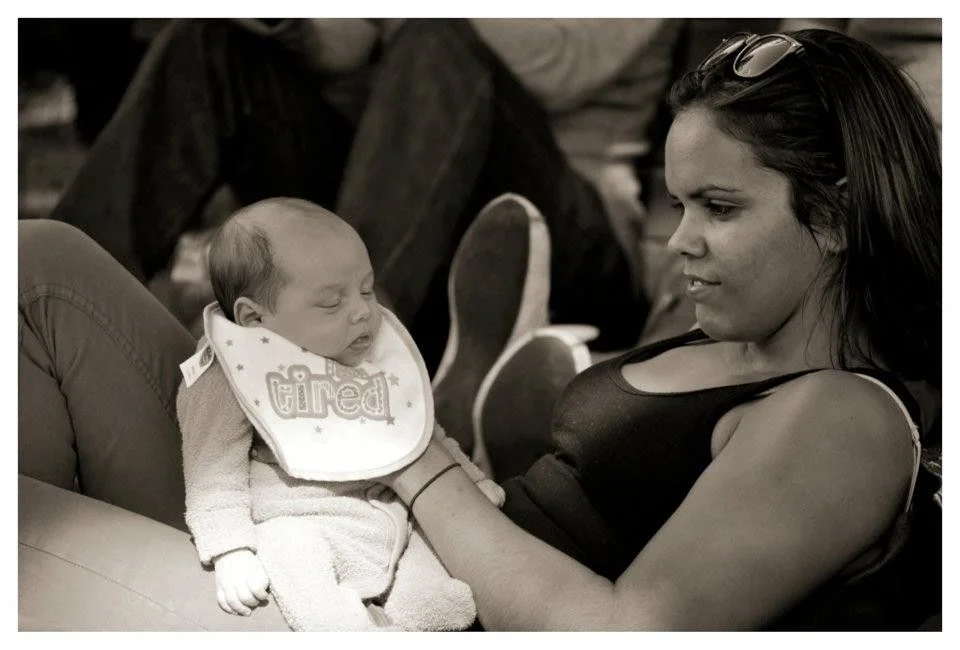
On the quiet moments: The most affecting images from the day were not the speeches or the formal ceremony — they were the quiet ones. A mother holding a newborn in a “tired” bib while the gathering happened around her. A man from the Indigenous Youth Health Service standing with his head bowed while someone spoke. A youth worker looking at the ground with an expression that contained the whole day.
On documentation: This was not a protest in the conventional sense — it was an assertion. The difference shows in the photographs. People were not performing for cameras. They were doing something that mattered to them regardless of whether anyone was watching.


