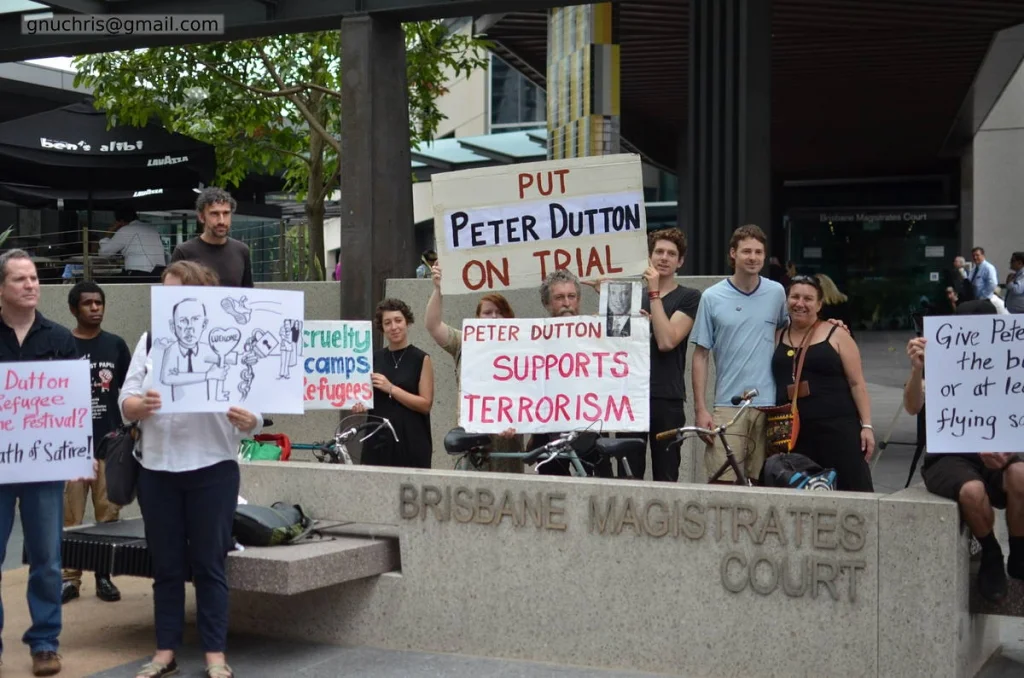


In November 2015, a protester was fined $1000 for demonstrating outside Peter Dutton’s electorate office. In response, a small group gathered outside Brisbane Magistrates Court — not a large rally, not a march, but the kind of focused demonstration that punches above its numbers because everyone there has thought carefully about why they are standing on that particular footpath.
I have photographed many protests over the years, and I find the small ones more interesting than the large ones more often than people expect. A demonstration of two hundred people in front of a court building, with hand-drawn signs and specific grievances, is more documentary than a crowd of five thousand. You can actually see the faces.
On the signs: The sign-making at this protest was genuinely good. “Put Peter Dutton on Trial.” “Peter Dutton Supports Terrorism.” “Give Peter Dutton the Boot… or at least a Flying Sand Shoe.” “The Death of Satire.” These were not just slogans — they were arguments, jokes, and accusations combined. Photographing them required getting close enough to read them while also including the person holding each one, because without the face, the sign is just text.
On the cartoon: Someone had drawn a detailed caricature of the Immigration Minister — complete and obviously laboured over. A protest sign that required that much effort is a statement about how seriously someone takes the issue. I photographed it being held up alongside other signs, which created a kind of visual conversation between different modes of argument.
On free speech: The irony embedded in this protest — that someone had been fined for demonstrating, and the response was more demonstrating — was not lost on the participants. There is something clarifying about that circularity. The best photograph of the day captured it implicitly: a group of people, in a public space, outside a courthouse, saying things that the government apparently would prefer they not say.
On small crowds: The intimacy of a small protest means that faces are visible, relationships between people are readable, and the scale of the response is part of the story. Twenty determined people outside a court tell a different story from twenty thousand people in a park, and both stories are worth telling.


