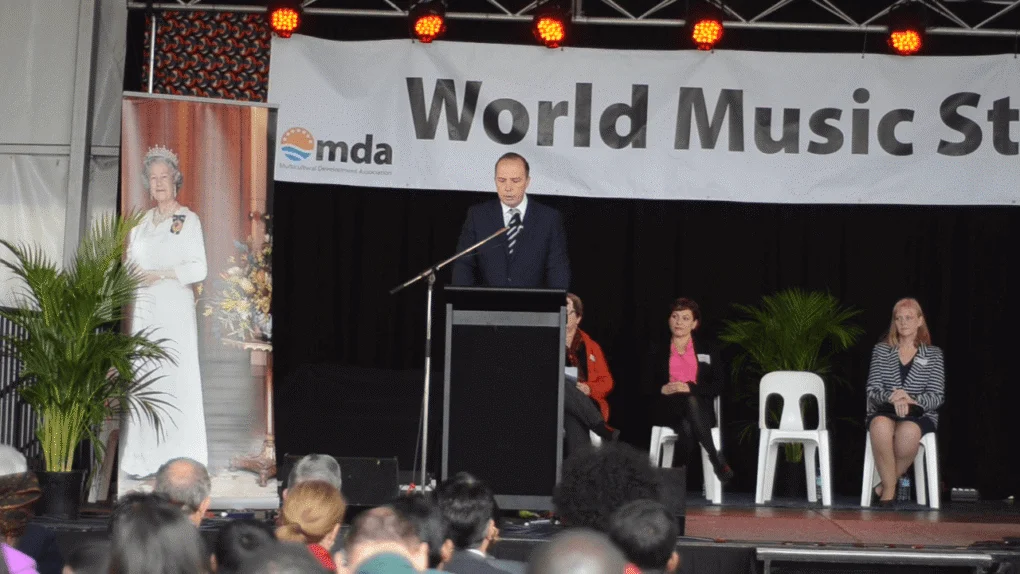

I had arrived at the Welcome Festival with a friend from the Lam Tu Luan Kung Fu School. We had been training through the night and decided to stay for breakfast and the opening ceremony. These multicultural festivals always begin the same way: local dignitaries, a council representative or two, and whoever the federal government has dispatched to say a few words about the importance of cultural diversity.
Immigration Minister Peter Dutton took the stage.
He had barely started speaking when a man in the crowd stood up and began shouting. “Free the asylum seekers. Free the children. Get them out.” He reached down, took off his shoes, and lobbed them in the direction of the minister. The security response was immediate and the man was removed.
On being in the wrong place at the right time: I have learned over many years of event photography that the photographs you remember making are rarely the ones you planned. I was at a multicultural festival to photograph a kung fu performance. I was not there to document a political incident. But the camera was with me, as it always is, and what happened happened.
On the limits of documentation: I have the image of Peter Dutton on stage before the incident. What happened in the moment itself is more difficult to capture in a still photograph — the throwing of shoes, the shouting, the removal — because it unfolded in seconds and in a crowd. The photograph I made is of the minister at the podium, at a multicultural festival, in front of a banner for a World Music Stage. The context does the work.
On the act itself: Throwing your shoes at a politician is a form of political expression with a long international history. Whether you agree with it or not, it is an image — a person removing what they stand on and directing it at the person they hold responsible. As a documentary photographer, my job is not to judge that act. It is to be present when it happens, and to find the frame that carries it faithfully.

