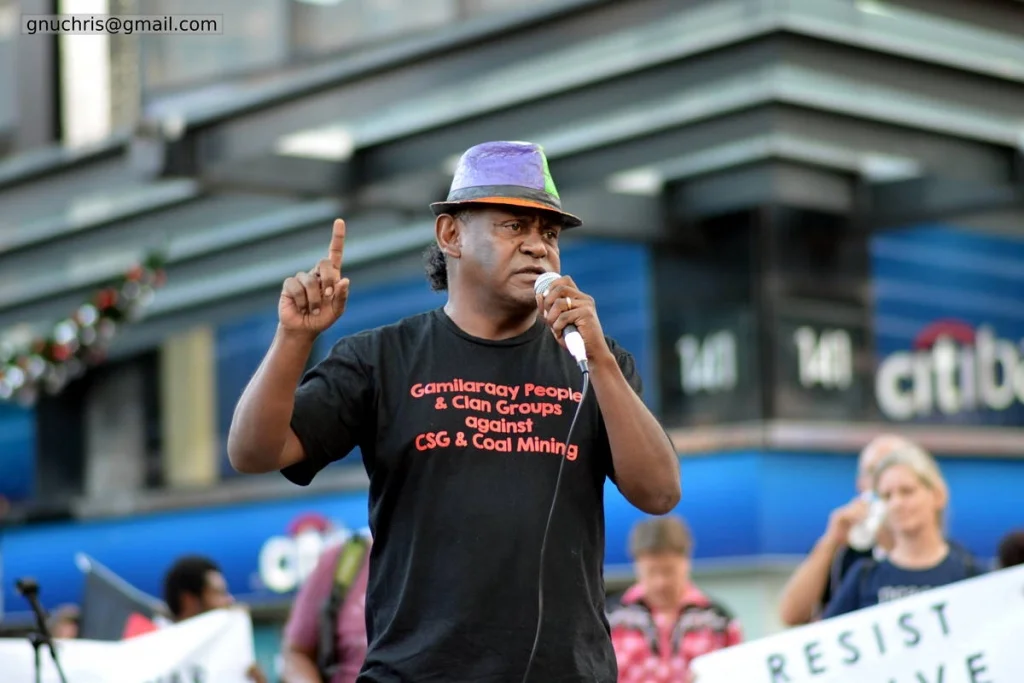


On 13 March 2015 — Black Friday, as it became known — hundreds of people gathered in Brisbane’s Queen Street Mall and then marched through the city centre in solidarity with Aboriginal communities facing forced closure by the Western Australian government. This was the fifth global day of action on the issue, and Brisbane’s response was loud, organised, and angry in the way that grief becomes when it runs out of patience.
I have been photographing activist events in Brisbane for years, and I came to this one the same way I come to all of them: early, without an agenda, and prepared to follow rather than direct.
On the speakers: The rally began with speeches, and the speakers at this event were among the most compelling I have photographed. A Gamilaraay man spoke about CSG mining and country; others spoke about children, about water, about what closure actually means for communities whose connection to land is not metaphorical but physical and legal. I stayed close to the stage and kept the aperture wide.
On the march: When the crowd moved into the mall the energy shifted. Banners unfurled, voices rose, and the orderly queue of shoppers on either side of the march became something more complicated — curious, uncomfortable, sometimes confrontational. Those edges are where documentary photography happens.
On what I am there to do: At events like this I am not neutral and I do not pretend to be. But I try to be accurate. The photographs I make at a protest belong to the people in them, and I take that seriously. I do not frame, crop, or caption in ways that misrepresent what I saw. That constraint is not a limitation. It is the whole point.
The forced closure policy was eventually scaled back following sustained national and international pressure. These photographs are a small part of the record of that pressure.


