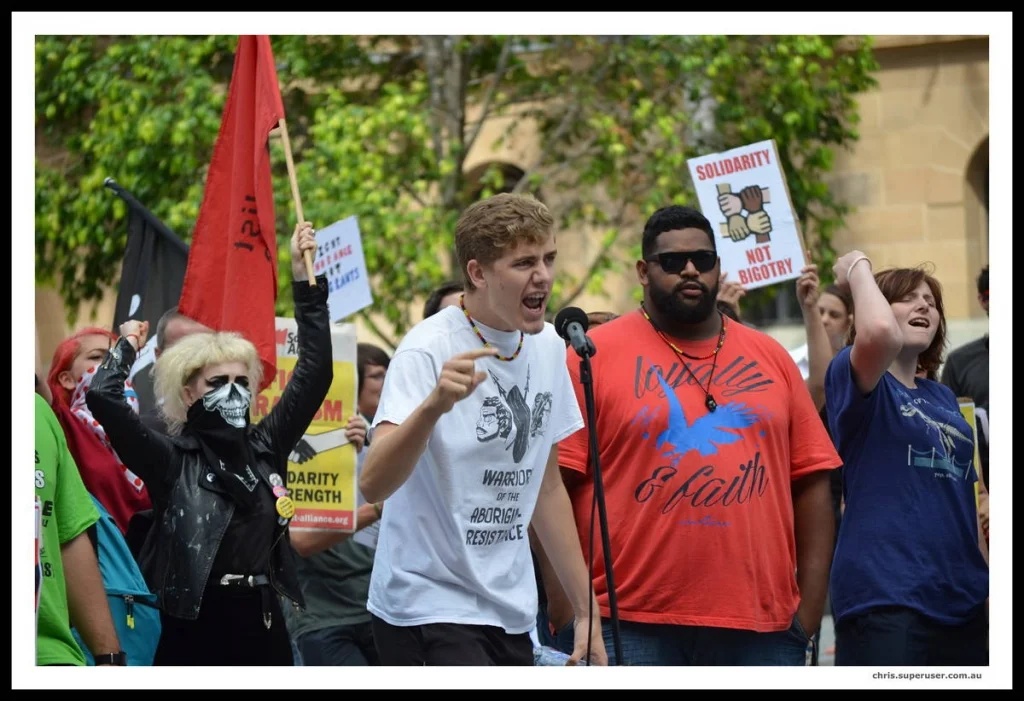


The Reclaim Australia rallies were a strange flashpoint in Brisbane’s political life — a nationalist movement that framed itself around protecting Australian values while being vigorously opposed by a counter-protest that argued those values were actually theirs. Both groups showed up. I photographed the counter-protest.
The two crowds were separated by police, which made for a peculiar visual environment. On one side, Australian flags and printed t-shirts. On the other, hand-made signs and a more chaotic energy. My sympathies were not in question, but I tried to photograph what was actually there rather than what I wanted to see.
On photographing conflict: When two opposing groups are separated by a police line, the temptation as a documentary photographer is to work the line — the moment where the two sides are closest, where the tension is highest. But the most interesting photographs from days like this are usually not at the line. They are in the crowd: a woman holding a sign that says “We All Walk on Aboriginal Land” with a cancelled swastika painted on it, standing very still and certain. That image does more work than any confrontation shot.
On humour in protest: The sign that stopped me in my tracks said “Say No to Bigotry. Choose Wizardry.” It had cats on it. The woman holding it was entirely serious in her delivery, which is what made the photograph work. Protest humour is often more effective than outrage as communication — it is harder to dismiss, harder to get angry at, and it stays in the memory longer.
On the flags: The Reclaim Australia side was carrying a significant number of Australian flags, which created visual problems I hadn’t anticipated. Flags in movement against sky read as one thing; flags draped over people’s bodies read as something else entirely. I was conscious throughout of not making anyone’s signage do more work than it was doing in reality. The photograph should show what was there, not editorialize.
On police presence: The heavy police line between the groups meant that the counter-protest effectively took place behind a wall of fluorescent yellow. That is its own kind of image — the state’s apparatus physically separating citizens who disagree with each other. I photographed that separation as well as what was happening inside it.


