

Three years in a row to the same festival is a test of whether a place has depth or just novelty. Abbey passes that test every time. Each year I find something I missed the year before — a performer I had not noticed, a corner of the market ground with different light, a bout that unfolded in a way I had not anticipated.
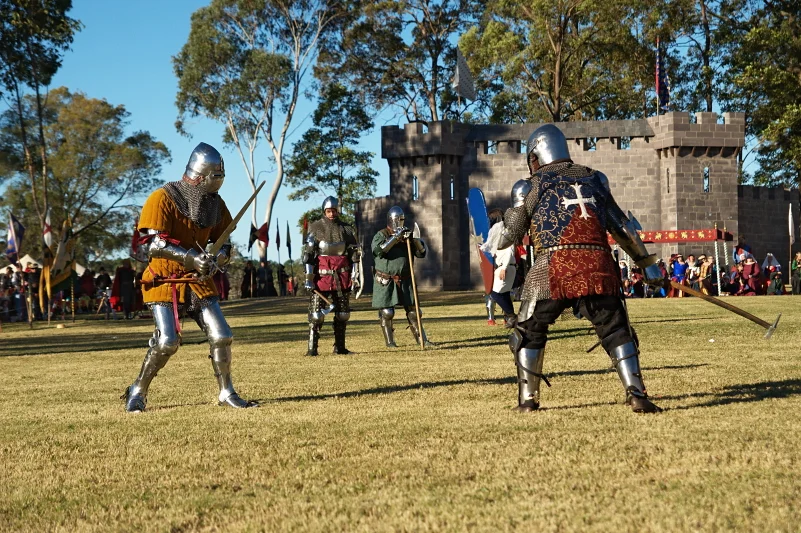
This was also the year they built a proper castle facade as backdrop for the main arena, and it changed the jousting photographs completely. Suddenly the images had historical weight that the open grass field could not provide.
On the light: Abbey runs across a full weekend, and the light shifts dramatically over those two days. The morning sessions are flat and even — good for detail shots of armour and costume. By late afternoon the sun drops low and everything goes amber, and the combat photographs take on a quality I could not replicate in a studio if I tried.
On the rapier bouts: The rapier duels are less chaotic than the melee combat and more technically demanding to photograph. Two people moving with precision, in and out of distance, reading each other — the decisive moment is subtle. I shot a lot of frames and kept very few, but the few I kept from the golden-hour session are among my favourite images from any festival.
On the dancers: The folk dancers usually perform late in the day when most visitors are focused on the main arena. I found them by accident and stayed for an hour. The spinning skirts and low light gave me the kind of natural motion blur that you cannot manufacture — you just have to be there.
This festival remains my favourite event to photograph in Queensland. The combination of spectacle, historical sincerity, and extraordinary light is hard to beat.
More Abbey Medieval Festival coverage: Abbey Medieval Festival 2010 · Abbey Medieval Festival 2012 · Abbey Medieval Festival 2014


