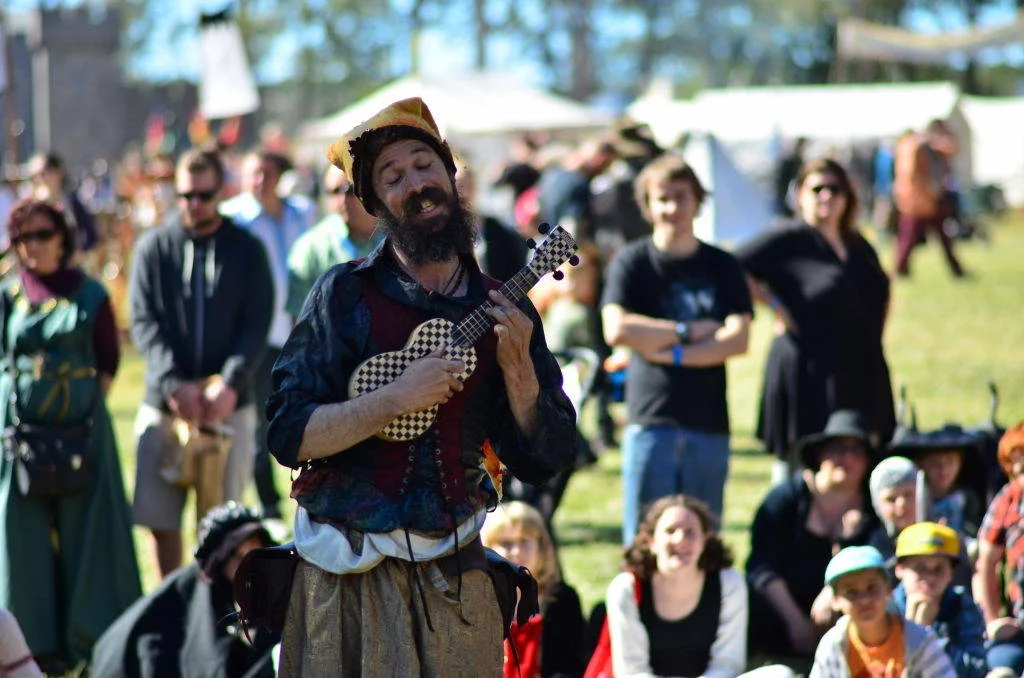


The jester with the chequered ukulele is the image that defines the 2014 festival for me. He had a small crowd gathered around him, performing completely without irony — deeply committed to a version of the medieval world that included his particular kind of absurdist humour. The crowd was laughing, the sun was behind him, and he had his eyes closed. I got one frame that worked.
Abbey in 2014 felt more mature than the early years — the demonstrations were more refined, the market more substantial, the performance spaces better organised. The food display in the medieval kitchen tent was extraordinary: a long trestle table covered in period-accurate vegetables, eggs, dried herbs, and clay vessels, arranged as if someone was about to cook a feast. I spent twenty minutes photographing it.
On the kitchen demonstration: A woman in rough-spun linen was grinding grain on a stone quern while a small crowd of children watched. The children were clearly fascinated. She was clearly used to the children. That gap in attention — the demonstrator absorbed in the task, the audience wide-eyed — is one of my favourite dynamics to photograph.
On the female fighters: There were several women competing in the main combat bouts this year, and the photographs they gave me were among the best of the day. The fighter in black-and-gold armour had a quality of presence that read beautifully through the lens — focused during combat, genuinely warm in the moments between.
On returning: This was my fifth year. I know the ground well enough to plan. I know the light patterns. I know where the good portraits happen. That knowledge means I waste less time and make better photographs. There is an argument for going back to the same place, repeatedly, until you understand it.
More Abbey Medieval Festival coverage: Abbey Medieval Festival 2010 · Abbey Medieval Festival 2011 · Abbey Medieval Festival 2012


