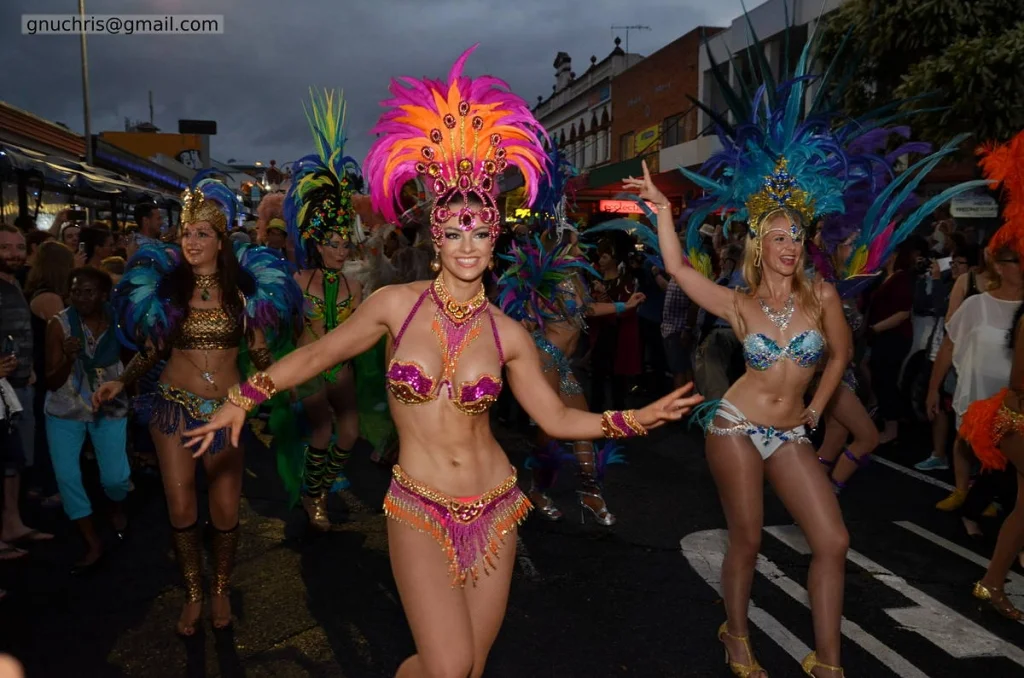


The Boundary Street Festival closes a stretch of West End’s main commercial strip and turns it into something you would expect to find in a city twice Brisbane’s size. Samba schools, capoeira groups, food stalls, live music on multiple stages — and a crowd that fills the street from kerb to kerb for hours.
I have photographed this event several times and the challenge is always the same: there is too much to photograph and the light is always moving. The festival runs into the night, which means you start in available daylight and end up working with street lighting and stage wash. Both present different problems. I prefer the later hours, when the colour of the costumes is lit from below and the sky behind goes from blue to black.
On the samba: The samba schools are the visual centrepiece of the event. The costumes — hand-sewn, beaded, feathered — represent months of preparation, and you can see it. Close-up portraits of the dancers reward a longer lens; wide shots showing the full parade require getting off the footpath entirely. I spent most of the parade moving between the two registers.
On the capoeira: The capoeira demonstration stopped the crowd on a side street. A ring formed around two practitioners working through a ginga, and the inversions and kicks that followed happened at a speed that required pre-visualisation rather than reaction. I watched two full sequences before I started shooting. By the third I had the timing.
On the light: The worst light at this event is the transition between sunset and full dark — the sky bleeds colour but the street level is not yet lit strongly enough to give clean exposures. Twenty minutes either side of that transition and the images are easy. During it, they require commitment to a high ISO and an acceptance that some frames will have noise.
The Boundary Street Festival is one of the events on the Brisbane calendar I never miss. It has the particular energy of a community that has decided to celebrate itself.


