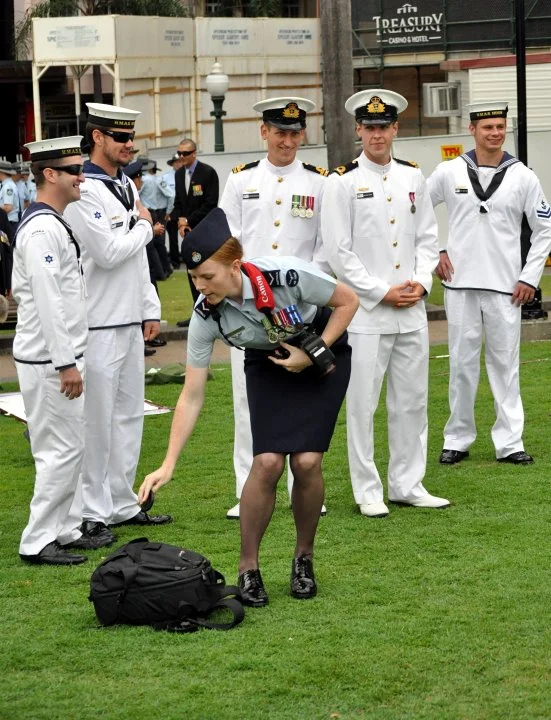


I have photographed Anzac Day in Brisbane most years for over a decade. It is the one morning in my calendar where I do not think about portfolio work or social media or whether the light is any good. I go because it matters, and the camera comes with me because it is how I pay attention.
The dawn service changes you if you let it. There is a particular stillness at 4:30 in the morning when hundreds of people gather in the dark around a cenotaph — a stillness you cannot manufacture and cannot rush. My job in those first minutes is to disappear. Any photographer who treats that silence as an opportunity for dramatic framing has missed the point entirely.
On restraint: The hardest thing I have learned about documentary photography is that the best images often come from holding back. At a dawn service I will sometimes spend the first twenty minutes with the camera at my side, just watching — reading the crowd, finding the faces that are carrying something, noting where the light will land when the sky eventually lifts. Patience here is not waiting for action. It is waiting for truth.
On permission: I always ask before I photograph individuals at commemorations. Not because the law requires it — it doesn’t — but because a nod or a small smile from a veteran before I raise the camera changes what the photograph becomes. It becomes collaborative. The person in the frame is not my subject. They are my collaborator.
On the crowd: The march itself is different from the service. There is pride and noise and flags and families. I find myself drawn to the edges — the elderly man watching from a wheelchair on the footpath, the child who has fallen asleep against her grandmother’s shoulder, the young digger three rows back who is trying not to cry. The story of Anzac Day is never just in the official ceremony. It is in those margins.
On what the images are for: I do not sell Anzac Day photographs. I share them freely, and when veterans or their families ask for prints I give them without charge. These images belong to the community that made them possible. My name on the file is a record, not a claim.
The first time I printed a large-format image from an Anzac Day service and an old man recognised himself — standing straight, medals on, looking at the memorial — he was quiet for a long time. Then he said: I didn’t know I still stood like that. That is what this work is for. Not the archive. Not the award. That moment of recognition.
More ANZAC Day coverage: ANZAC Day Photos 2010 · How to Photograph Anzac Day · ANZAC Day Brisbane 2013 · ANZAC Day Brisbane 2023


