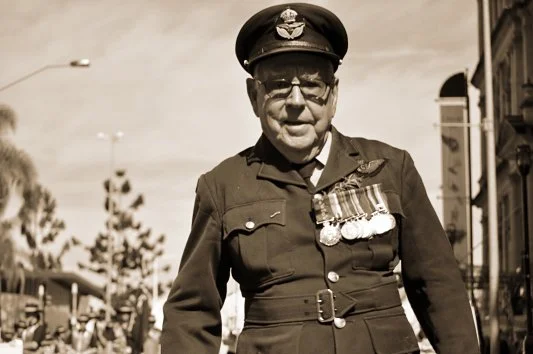


Anzac Day is one of the few events in the Australian calendar where people genuinely do not want to be photographed, and that constraint turns out to be the most useful teacher I have had in twenty years of event work.
When you cannot rely on subjects turning toward the camera and smiling, you have to develop different skills. You learn to read a crowd rather than manage it. You learn to be invisible. You learn that the most powerful images of public occasions are almost always candid — people in their own world, doing their own things, with no awareness that someone is watching.
On planning: The Anzac Day march in Brisbane runs through the CBD and the layout of the route matters enormously for photography. I walk it the day before, or at least early in the morning before the barriers go up. Where does the sun sit at 10am? Where does the route turn and compress the crowd? Where do the veterans slow down? These questions have answers if you look for them.
On respectful distance: I do not use a long telephoto as a way to photograph people without their knowledge. If I am close enough to shoot, I am close enough to be seen — and I carry myself accordingly. At a commemorative event this means moving slowly, not blocking sightlines, not repositioning aggressively while something solemn is happening. Being invisible is not the same as being absent.
On medals: The medals are the hardest thing to photograph well because they are also the most obvious subject. Every person with a camera points at the medals. What I try to find instead is the relationship between the medals and the face above them — the weight, the age, the fact that a person’s entire service history is reduced to a row of small metal discs on their chest.
On the margins of the march: The most interesting photographs of Anzac Day are not usually in the march itself. They are in the hour before, when veterans are gathering and greeting each other, and in the hour after, when the formal structure has dissolved and people are just people again.
On why it matters: I photograph Anzac Day because the people marching will not always be there to march. These images are a record that will outlast the subjects. That is a responsibility. I try to live up to it.
More ANZAC Day coverage: ANZAC Day Photos 2010 · ANZAC Day Brisbane 2013 · Capturing the Essence of Anzac Day · ANZAC Day Brisbane 2023


