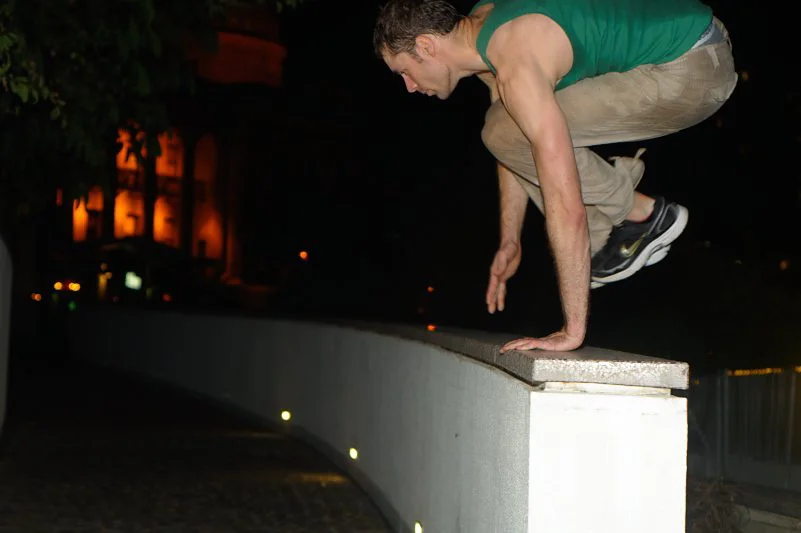


I followed a group of Brisbane parkour practitioners through the CBD one Thursday evening, and what I came away with was not just photographs of people jumping over things. It was something stranger and more interesting — a record of people reading the city differently.
To a traceur, a wall is not a boundary. It is an object with a top side and a relationship to the surrounding space. A pole is not infrastructure — it is something to test yourself against. Watching this group move through King George Square and along the river precinct, I became aware of how completely I had stopped seeing those spaces. They had learned to see them again.
On shutter speed and light: Photographing parkour at night requires a different set of trade-offs from daytime action work. You cannot freeze motion without raising ISO into the range where the image gets grainy, and you cannot use a slow shutter without blurring the subject. I ended up working at around 1/200 of a second and accepting some grain, which turned out to suit the material — the grittiness of the images matched the physical reality of vaulting concrete in the dark.
On positioning: The temptation with action photography is always to get wide and include everything. With parkour I found the opposite worked better — getting tight on a specific moment within a longer sequence, letting the city lights become a blur of colour in the background. The image of someone crouching on a high wall against a softened cityscape communicates something about the relationship between the athlete and the city that a wide shot would dissolve.
On the portrait: I photographed one of the practitioners standing still, looking down, in the moment before he decided what to attempt next. No action, no drama — just a person preparing. That image is as much a parkour photograph as any of the vaults. Preparation is practice. The body thinking is the body moving.
On community: What surprised me most about this evening was how collegial the whole thing was. These were not competitive athletes. They encouraged each other, spotted each other on new attempts, waited while someone tried something they had been working on. The culture of it was generative and patient in a way I had not expected.


