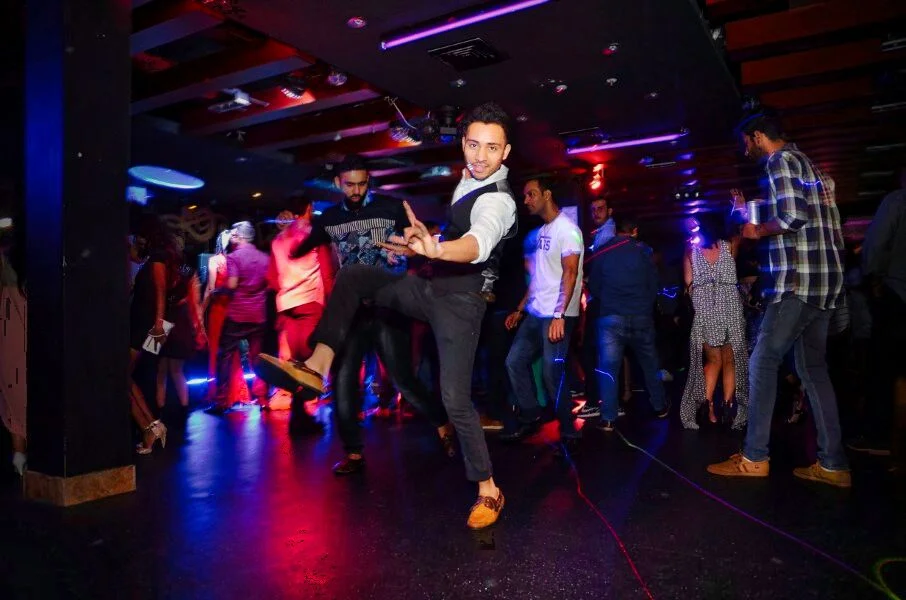


Nightlife photography is one of those disciplines that sounds glamorous until you are actually doing it: loud, dark, crowded, unpredictable, and technically unforgiving. Your camera wants to overexpose the highlights, blur the shadows, and freeze at the worst possible moment. Learning to work against all of that is what makes it interesting.
I came to nightlife photography through event work — covering parties, launches, club nights — and what I found was a school unlike any other. Every other kind of photography gave me some control: I could ask people to stand still, wait for the light, choose my angle. In a dark room with a DJ and four hundred people, control is not really available. You have to let go of it and work differently.
On equipment and settings: A fast prime lens is not optional in these environments — it is the difference between images and noise. I work mostly at f/1.8, push the ISO as high as the camera can handle cleanly, and use the available light creatively rather than trying to overpower it with flash. When I do use flash, I bounce it off whatever surface is available or use a small diffuser to soften the output. Direct flash at a nightclub is the fastest way to make everyone look like they are in a police photograph.
On connection: The most common mistake in nightlife photography is treating the people as scenery. They are not. Every person in that room is a subject with their own story, their own reason for being there. When you approach that with genuine curiosity rather than transactional efficiency, people feel the difference — and your photographs reflect it.
On the dance floor: Dance floor photographs require the same timing skills as any action photography, but the action is unpredictable and constant. I look for the peak of movement — the fully extended kick, the moment the crowd surges — and I fire there. Most frames will miss. The ones that land are worth all the misses.
On working with subjects: Brisbane has a nightlife that reflects the city’s diversity — and that diversity is one of the great gifts to a photographer. If you are open to it, a single night out can give you portraits that span the world.


