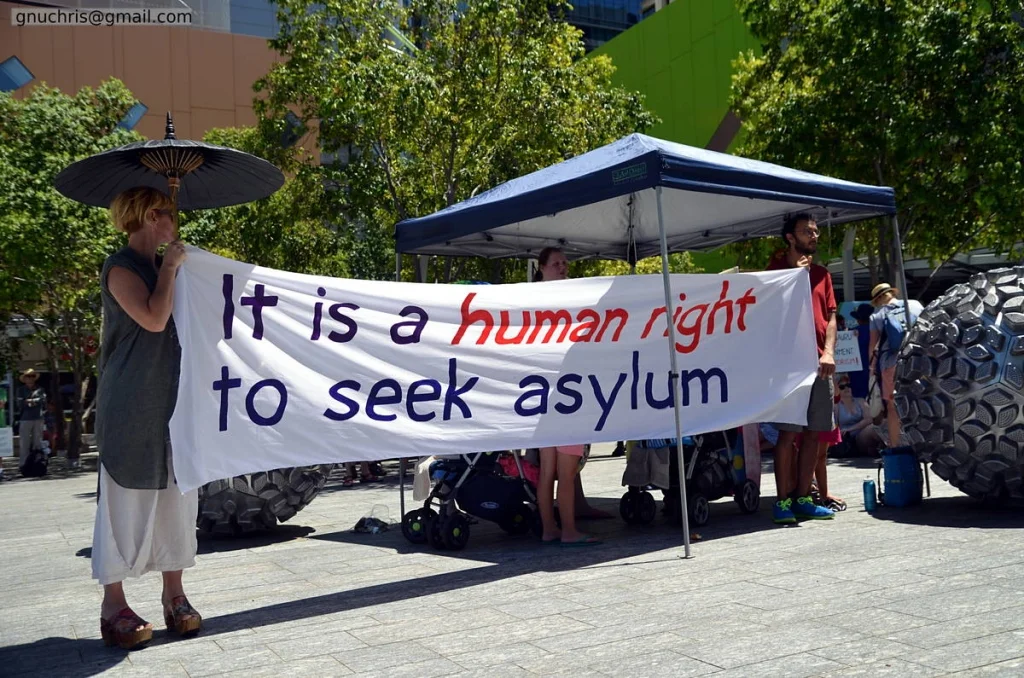


The weekend after Donald Trump signed his first travel ban, protests appeared around the world. In Brisbane, they gathered at South Bank and moved through the CBD — not just in response to Washington, but to Canberra too. The parallels between the Trump administration’s treatment of immigrants and Australia’s own offshore detention regime were obvious to everyone there, and the signs made it explicit.
I have photographed a lot of demonstrations over the years and what struck me about this one was the quality of thought that had gone into it. People had not just shown up. They had made things — banners, signs, costumes — that communicated arguments. The woman with the “The Only Camp We Need” sign had glued celebrity photos to cardboard and written a joke that landed harder than anything a speechwriter could have drafted.
On political photography: I try not to approach protest photography as a neutral observer — I have views, and the people at these events have earned the right to be photographed by someone who understands what they are doing. But I also try not to be a propagandist. The photographs are more useful if they are honest rather than flattering.
On the crowd: What I remember most about this particular protest is how varied the crowd was. Students and union members, elderly people with umbrellas, young families with children on their parents’ shoulders. The breadth of a demonstration tells you something about whether an issue has crossed into general public consciousness — and this one had.
On speakers: I always work close to the rally stage because the speakers’ faces are where the argument lives. A woman in a “Free the Refugees” shirt at a microphone, reading from notes she has memorised — that is worth more than any crowd shot. The conviction in a face is the photograph.
On the signs: The best sign at any protest is the one someone clearly made at 2am, driven by something they could not stop thinking about. You can always tell those signs from the pre-printed ones. They have a texture to them, an urgency, that does not reduce to talking points.
This was one of those afternoons that reminded me why I started carrying a camera to these events in the first place — not because the work is comfortable, but because it matters.


